221 Lectures Rescued in 5 Automated Phases
Automated archive audit and cloud migration for a terabyte-scale media library — from scattered drives to verified cloud backup.
221
Lectures recovered600+
Lectures audited5
Automation phases0
Data lossThe Challenge
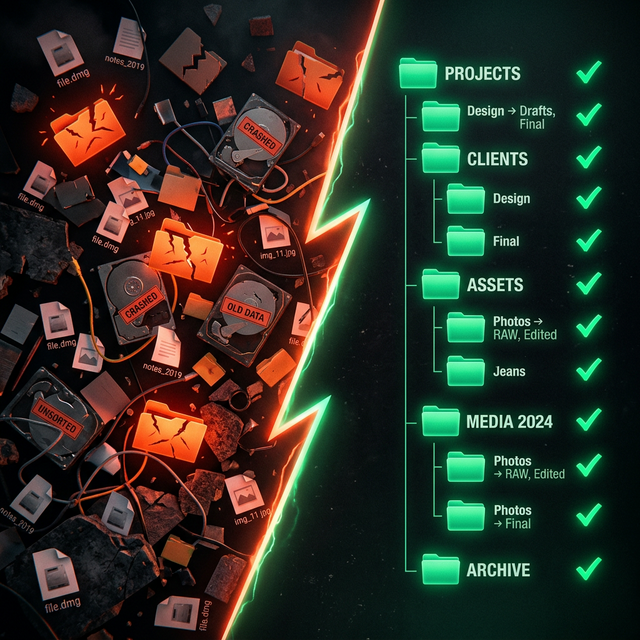
The full KCE library — the same ~600 lectures my team produced — sat scattered across multiple drives. Inconsistent naming, missing files, broken folder structures. No inventory, no verification. The audit later showed 221 of them were at real risk: absent from manifests, misnamed, or corrupt. One drive failure away from permanent loss.
Manual sorting would take weeks and miss gaps. The archive needed systematic processing, not human patience.
The Approach
Designed a 5-phase automated pipeline:
Phase 1 — Discovery: Python scripts crawl all storage, build complete inventory, identify duplicates and gaps.
Phase 2 — Sorting: Automated categorization by course, type, and sequence via filename parsing and metadata extraction.
Phase 3 — Audit: Cross-reference against course manifests. Flag missing lectures, corrupt files, version conflicts.
Phase 4 — Verification: Automated integrity checks — codec, resolution, duration, audio sync.
Phase 5 — Cloud Sync: GoodSync deployment to OneDrive with verified mirroring and change tracking.
Discovery
Crawl all storage, build inventory
221 files foundSorting
Categorize by course, type, sequence
20 courses identifiedAudit
Cross-reference manifests, flag gaps
0 missing filesVerification
Integrity checks: codec, resolution, sync
100% validatedCloud Sync
GoodSync → OneDrive, verified mirroring
Fully synced
Timeline showing 5 automation phases: Discovery, Sorting, Audit, Verification, and Cloud Sync.
The Result
All ~600 lectures audited, verified, and cloud-synced. The 221 that would have been lost were recovered. Zero data loss, and the process is documented and repeatable for future archives.